





Oil prices rose by around 7% after U.S. President Donald Trump announced the introduction of navigation restrictions in the Strait of Hormuz. These measures follow the failure of negotiations with Iran held over the weekend.
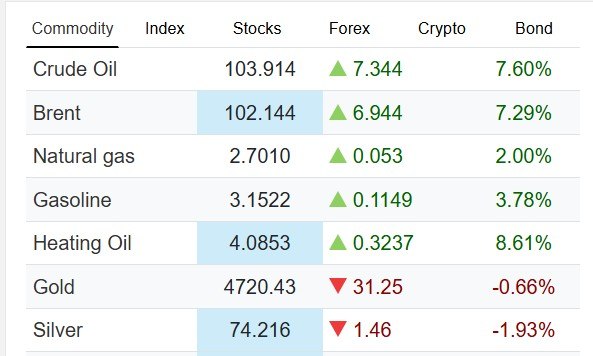
The restrictions are not total: they apply only to vessels entering or leaving Iranian ports. Nevertheless, the mere fact of intervening in one of the world’s key trade corridors triggered an immediate market reaction. Before the conflict, up to 20% of global oil and gas exports passed through the Strait of Hormuz, making it a critical chokepoint for global energy stability.
Talks held in Pakistan did not lead to an agreement. The United States accused Tehran of refusing to limit its nuclear ambitions. Iran, for its part, put forward a series of demands, including control over the strait, military reparations, a broader regional ceasefire, including in Lebanon, and access to frozen overseas assets. The gap between the two sides proved fundamental.
Against this backdrop, Saudi Arabia announced the restoration of full capacity on its east-west pipeline, allowing oil exports via the Red Sea while bypassing the Persian Gulf. The resumption of production at the Manifa oil field was also confirmed. These steps are intended to partially offset potential supply disruptions.
Despite the price increase, the most pessimistic forecasts from analysts have not materialized at this stage. These include scenarios in which oil could rise to $140 or even $200 per barrel in the event of a full blockade of the Strait of Hormuz. For now, restrictions remain limited, and no physical supply shortage is observed in the market. The current level, around $100 per barrel, remains sensitive for the global economy. However, when adjusted for dollar inflation, it corresponds to roughly $70 in the early 2010s or about $50 in the early 2000s.
