




While economists complain about Europe’s stagnation, IMF data tells a strikingly different story depending on whether you look East or West. Some countries are rapidly closing the gap with the United States; others are falling steadily behind.
For a decade, economists have lamented Europe’s stagnation and they’re not wrong. But their gaze remains fixed on the West, while an entirely different story is unfolding at the other end of the continent. Poland entered the millennium at 34% of American GDP per capita; the IMF projects it will reach 67% by 2030. Romania will climb from 27% to 60%, Lithuania from 29% to 69%, Bulgaria from 23% to 53%. These countries remain far poorer than the United States. But the gap is narrowing, and quickly. For the nations that made full use of EU membership, the Union has delivered exactly what it promised: a convergence machine.
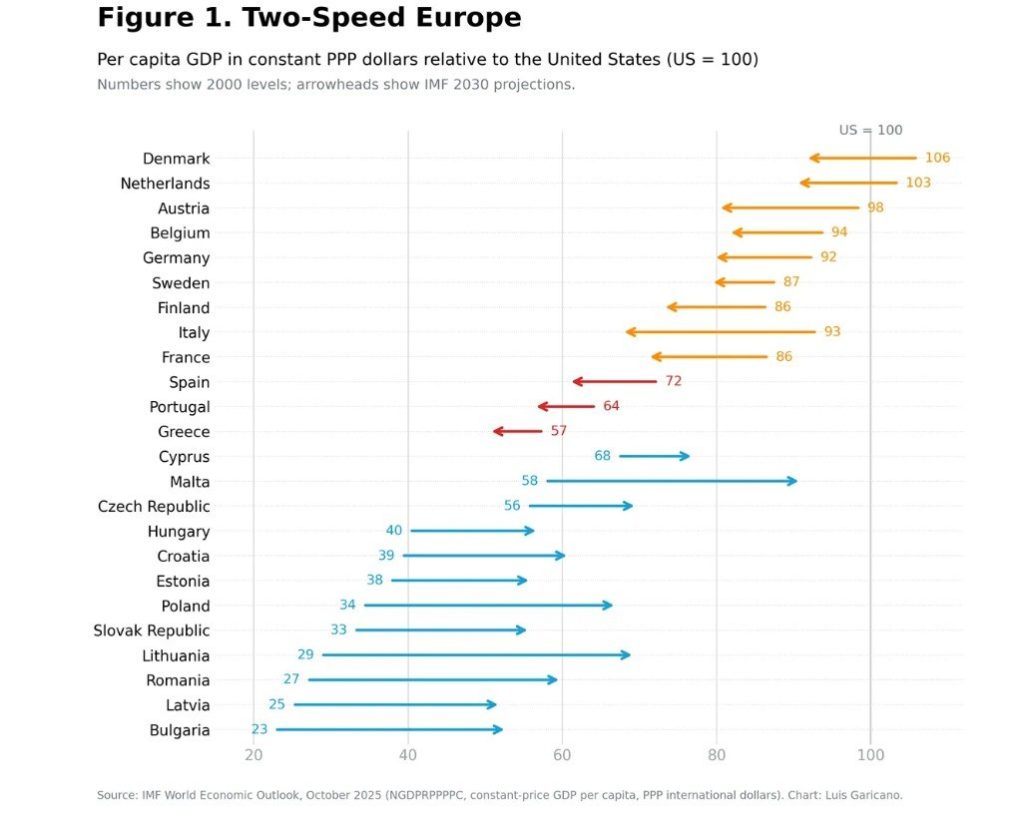
At the other end of the continent, the picture is reversed. Portugal slides from 64% to 57%, Spain from 72% to 61%, France from 86% to 71%, Italy from 93% to 68%. That last figure deserves a pause: a country that in 2000 nearly matched the American standard of living will, by the end of this decade, find itself roughly where the Czech Republic stands today. This is a structural trend. Western Europe is not declining in absolute terms, but in relative ones, and the gap keeps widening.
There is no shortage of explanations, but one remains unjustly overlooked: war. The Russia-Ukraine conflict has accelerated what was already in motion. Economists Tim Besley and Torsten Persson demonstrated long ago that when a state faces a genuine threat to its existence, something shifts in the very logic of power. Elites that had been content to extract rents suddenly discover an interest in making the country actually work, because their own survival now depends on it. Money begins flowing toward tax administration, courts, infrastructure, schools, the military.
It sounds like a universal formula but Besley and Persson were quick to add a caveat: the mechanism only works where there is something to build on. South Korea in the 1960s is the textbook case. Park Chung-hee came to power at a moment when the North appeared stronger by every measure. But he inherited a functioning state apparatus and redirected it: export discipline, infrastructure, education. Israel and Taiwan followed similar paths — fear of an aggressive neighbor became the fuel for growth designed to sustain long-term deterrence. In Pakistan or Egypt, the same threat produced nothing comparable: institutions were too weak to convert pressure into development.
Central and Eastern European countries find themselves in a fundamentally different position. Their Soviet past left them with bureaucratic structures that carried real capacity; two decades inside the EU strengthened them further. When war arrived at their doorstep, these states already had the means to respond. The result is visible in the IMF’s chart.
Within a few years, Lithuania will likely be wealthier than Portugal in GDP per capita. Poland will be within reach of Spain. The old mental map, a rich West, a catching-up East, is becoming obsolete. The speeds have switched sides.
