





In a single decade, the share of young Chinese women who don’t want children has risen from 6% to 47%. Demographers speak of a “rupture” and disagree about what caused it.
By 2023, nearly half of Chinese women aged 18 to 24 said they did not want children at all. A decade earlier, only about six in a hundred answered that way. The figures come from a 2026 working paper, “The Rise of Zero Fertility Desire in China,” written by a researcher affiliated with Brown University and so far released as a preprint (Research Square / ResearchGate). The author draws on six waves of the China General Social Survey (CGSS) spanning 2012–2023. An important caveat for the reader: the study has not yet been peer-reviewed, and it concerns not childlessness as a fact but a stated desire — how young people answer the question of whether they want children. The author stresses this distinction: not having children because of circumstances is one thing; consciously rejecting the very idea of parenthood is another.
What the data show
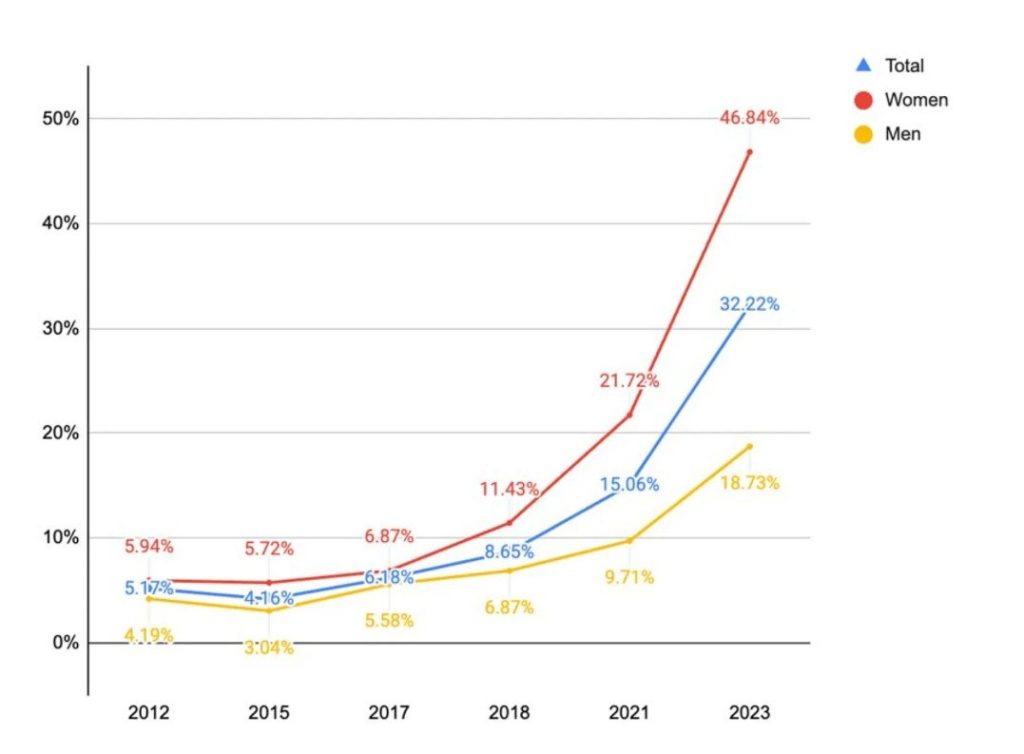
Among all young people aged 18 to 24, the share who don’t want children rose from 5.17% in 2012 to 8.65% in 2018, 15.06% in 2021 and 32.22% in 2023. In other words, the figure roughly tripled over the 2010s and then doubled again in just two post-pandemic years.
But behind that average curve lies a far sharper gender divide. For women: 5.94% (2012) → 6.87% (2017) → 11.43% (2018) → 21.72% (2021) → 46.84% (2023). For men, the rise is markedly more restrained: 4.19% → 5.58% → 6.87% → 9.71% → 18.73%.
The study identifies two periods. Until 2018, the rates held at around 5% or below, the desire to have children remained nearly universal. Then came the “rupture”: from 2018 to 2023 the curve shot upward, and most steeply among women. Whereas in 2012 men and women answered in roughly the same way, by 2021 the gap had reached 12 percentage points, and young women had become more than twice as likely as men to say they did not want children. By 2023 the ratio approached two and a half to one: about 47% versus roughly 19%.
The regression analysis yields another significant finding: gender turns out to be the most consistent predictor of “zero desire”, more so than level of education. Moreover, women with a higher-education degree forgo parenthood more often than their peers without one, while the difference between city and countryside is, among women, not statistically significant.
Why East Asia in particular
China is no exception here. Ultra-low fertility and a growing reluctance to have children are characteristic of all of East Asia — South Korea, Japan, Taiwan — and are gradually emerging in Thailand and the Philippines. Several explanations have been put forward, and it is worth distinguishing hypotheses from established facts.
One of the interpretations under discussion is “compressed modernization.” According to it, in East Asia women’s liberation from the patriarchal order happened extremely fast, sometimes within the span of a single generation, whereas in the West that process stretched over centuries. Women’s access to education and careers surged ahead, but social expectations — the domestic burden, the role of the “good wife and mother,” family pressure — failed to keep pace. The resulting gap between new possibilities and old demands pushes many women to forgo motherhood. This explanation looks plausible, but it remains a hypothesis rather than a demonstrated cause.
Alongside it operate entirely measurable structural factors. The culture of overwork (the notorious “996” regime — from 9 a.m. to 9 p.m., six days a week) sits poorly with raising a child. The cost of housing in major cities and education expenses make a child an expensive undertaking. The labor market still discriminates against women with “family responsibilities” — employers often factoring in the risk of maternity leave. Add the traditional costs of marriage (a bride price paid to the fiancée, the expectation that the groom owns his own home) and post-pandemic uncertainty, and the abrupt jump of 2021–2023 ceases to look like a mystery.
The demographic trap: less desire, and a skewed market
This shift is superimposed on an inherited gender imbalance. Decades of the one-child policy, combined with a preference for sons, produced a distortion in the sex ratio at birth: at its peak it reached 118 to 121 boys per 100 girls (and close to 130 in some provinces), against a global norm of around 105. The result: millions of “surplus” men, known in everyday Chinese as guanggun, “bare branches.” Estimates vary, but the figure cited is on the order of 30 million men of marriageable age who may not find a partner; by some calculations, more than 10% of men born after 1980 risk never marrying.
Why this is geopolitics, not just sociology
China’s total fertility rate stands at around 1.3, well below the simple replacement level; the population is already shrinking, and the share of the elderly is rising. The authorities have rolled out a pronatalist policy — from easing restrictions to direct incentives. But if these measures target those who would like children yet run into obstacles (housing, money, daycare), they remain almost powerless where it is the desire itself that is fading. And it is precisely this component that, judging by the data, is growing fastest.
A declining and aging population directly affects the labor market, the pension burden, consumer demand and, over the long term, a country’s economic and strategic weight. In this respect East Asia serves as a leading indicator: South Korea with its record-low fertility, an aging Japan, Taiwan. China is moving along the same trajectory, only on an incomparably larger scale.
