





The military conflict in the Persian Gulf and the resulting oil and gas crisis have accelerated the transition of a whole range of economies, not only toward renewable energy sources but also toward biofuels. When supplies of conventional oil come under threat, biodiesel made from vegetable oils, animal fats, and recycled fats becomes an instrument of energy security.
United States
The U.S. Environmental Protection Agency (EPA) has tightened its requirements for renewable fuels for 2026 and 2027 and is considering raising the maximum share of ethanol in fuel blends to 15%. According to the estimates underlying the study, such a move could increase overall demand for biofuels by 40% within a short time frame. The EPA’s own forecasts confirm this expansionary trajectory: U.S. production of biomass-based biodiesel is expected to reach 17.9 million tonnes in 2026 and rise to 18.9 million tonnes in 2027.
Asia
Beyond the United States, the momentum is no less strong. India is accelerating its mandatory biofuel programs, while ASEAN countries are sharply raising their targets in an effort to reduce dependence on imported fossil fuels. Today, most Indian filling stations sell gasoline with a 20% ethanol content, but the government intends to go further: the country’s Ministry of Transport has proposed allowing the operation of vehicles running on fuel with an ethanol share of up to 85%, or running entirely on ethanol.
Southeast Asia is following a similar logic. Indonesia is legislatively raising the share of palm-oil-based biodiesel from 40% to 50%, while Malaysia has approved a gradual transition to fuel containing 15% biodiesel.
Europe
The German biodiesel market posted solid momentum in 2025. Consumption of this fuel in blends rose by 12%, reaching 2.2 million tonnes. By 2030, an increase to 3 million tonnes is forecast.
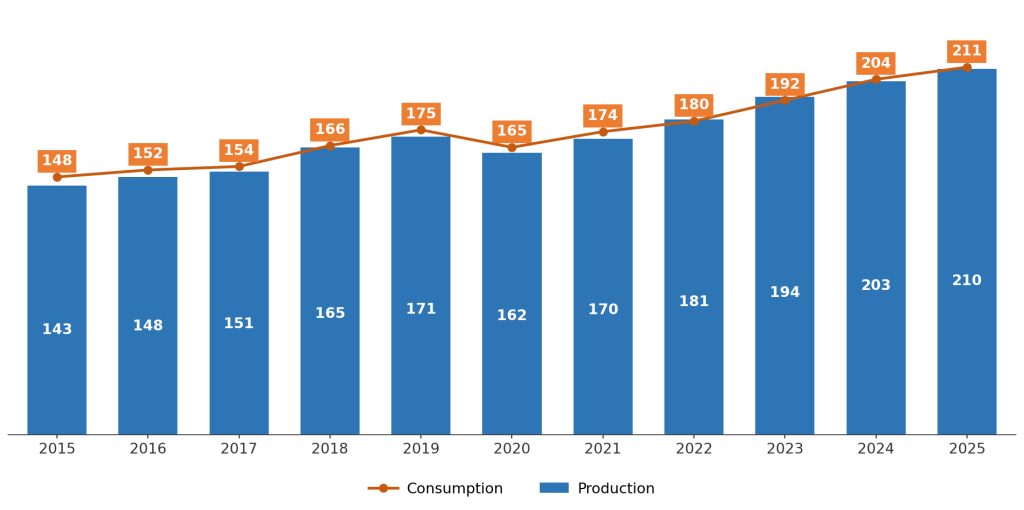
Over recent decades, global biofuel consumption has grown by an average of 3.3% per year, reaching 211 million tonnes by the end of 2025. Production has kept pace, reaching 210 million tonnes, up from 143 million tonnes in 2015. However, owing to the global energy crisis, the rate of growth could accelerate to 5–5.5% per year, equivalent to an additional 10.5–11 million tonnes annually. On a planetary scale, biofuels are already replacing close to 4 million barrels of conventional oil per day, and that share will only continue to grow.
