




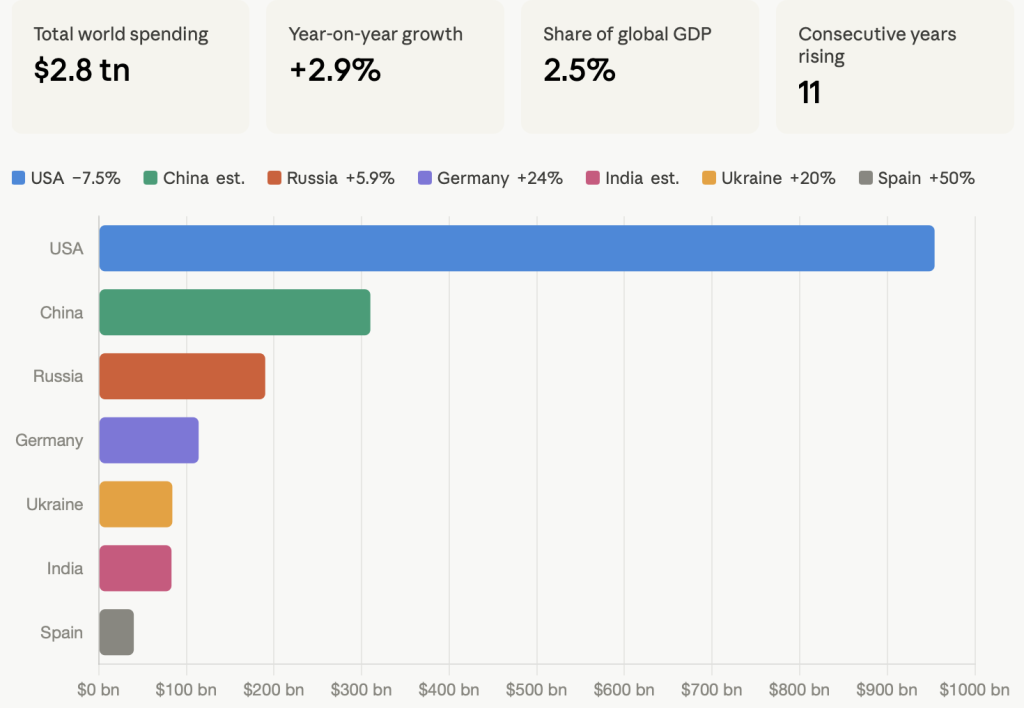
According to the annual report of the Stockholm International Peace Research Institute (SIPRI), published on April 27, 2026, global military spending rose by 2.9% in 2025 and crossed the $2.8 trillion threshold for the first time in history. This marks the eleventh consecutive year of increase.
The share of military spending in global GDP reached 2.5% — the highest level since 2009. Just fifteen countries account for 80% of all worldwide defense expenditure, and the top five: the United States, China, Russia, Germany, and India, together represent 58% of the global total.
The United States stays on top, but cuts spending
The United States retains first place with a budget of $954 billion, yet recorded a 7.5% decline compared to 2024 — its first drop in many years. SIPRI analysts attribute this partly to the absence of any new military aid packages to Ukraine throughout the year. The institute’s experts nonetheless consider this setback temporary.
Russia spends more, but at a slower pace
Russian military spending grew by 5.9% to reach $190 billion — the slowest rate of growth since the full-scale invasion of Ukraine began in 2022. For comparison, the increase stood at 38% in 2024. Russia holds third place in the global rankings, yet the military burden on its economy remains enormous: 7.5% of GDP, with one in every five rubles of public spending directed toward defense.
Ukraine, for its part, broke into the global top ten, ranking seventh. Its defense budget rose 20% to $84.1 billion, equivalent to 40% of the country’s GDP.
Europe: a historic turning point
The primary driver of the global rise in military spending in 2025 was Europe. The pace at which European NATO members increased their defense budgets was the fastest since 1953. As SIPRI researcher Jade Guiberteau Ricas noted, this reflects Europe’s push for strategic self-sufficiency alongside growing pressure from Washington over burden-sharing within the Alliance.
The combined spending of 29 European NATO members reached $559 billion, with 22 of them meeting the Alliance’s 2% of GDP target.
A symbolic milestone was Germany crossing the 2% of GDP threshold for the first time since 1990, dedicating $114 billion to defense — a 24% increase and a fourth-place finish in the global rankings. Spain made an even more dramatic leap, with its military budget surging 50% to $40.2 billion.
What’s next?
The SIPRI data paints a picture of a world in which rearmament has become the norm. The conflict in Ukraine, the redefinition of the United States’ role in European security, and broader geopolitical instability are pushing governments around the world to increase their defense budgets, sometimes at the expense of other areas of spending. Given current trends, this dynamic shows little sign of reversing anytime soon.
