




The superiority of the United States in GDP growth is almost entirely explained by the technology sector. In purchasing power parity terms, Europe has not fallen behind America for a quarter of a century. This is what the World Bank data shows.
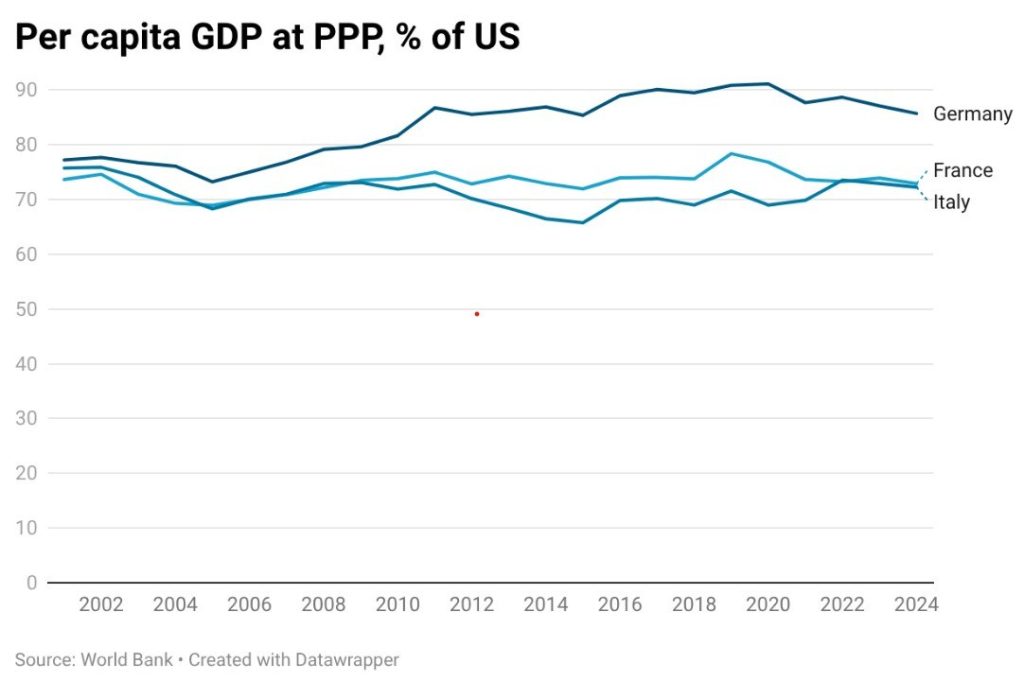
European economies do indeed produce less output per capita than the United States. But when we switch to purchasing power parity, that is, when we measure the real volume of goods and services that citizens can afford, the picture changes dramatically. In 2001, France’s GDP per capita at PPP stood at 74% of the American level. In 2024, this ratio has remained virtually unchanged: 73%. Germany, for its part, has even partially closed the gap over this period. Europe is not falling behind.
The key to understanding this paradox was offered by Nobel Prize-winning economist Paul Krugman. In his view, the United States’ superiority in GDP growth is almost entirely driven by one narrow segment of the economy: the technology sector. As acknowledged in the Draghi report, prepared for the European Commission, virtually all productivity gains in America have been delivered by the rapid growth of information technology, in which the United States now dominates.
But Krugman goes further. America’s technological supremacy does not so much enrich Americans at the expense of the rest of the world as it translates into global benefits through lower prices. Cheap cloud services, accessible search engines, free communications — all of this raises real living standards everywhere in the world, including in Europe. In other words, Europeans reap the fruits of the American technology boom without producing it themselves.
This does not mean that Europe is free of structural problems. But a correct understanding of the nature of American growth fundamentally changes the kind of questions that policymakers and analysts should be asking. Rather than asking “why is Europe losing to America?”, it would be more pertinent to ask: “how can we make the most of technologies developed across the Atlantic, and is it truly necessary to reproduce the American model at any cost?”
