

The conflict dragging on in the Persian Gulf is increasingly being reflected in the region’s financial markets. As geopolitical uncertainty rises, investors are reducing their exposure, and stock indices across several Gulf countries are declining. This trend is particularly visible in Dubai and Qatar.
Over the past month, Dubai’s stock market has fallen by about 11%, one of the sharpest declines in recent years. At the same time, there are currently no clear signs of a rapid de-escalation of the conflict in the region, meaning that pressure on the market could continue.
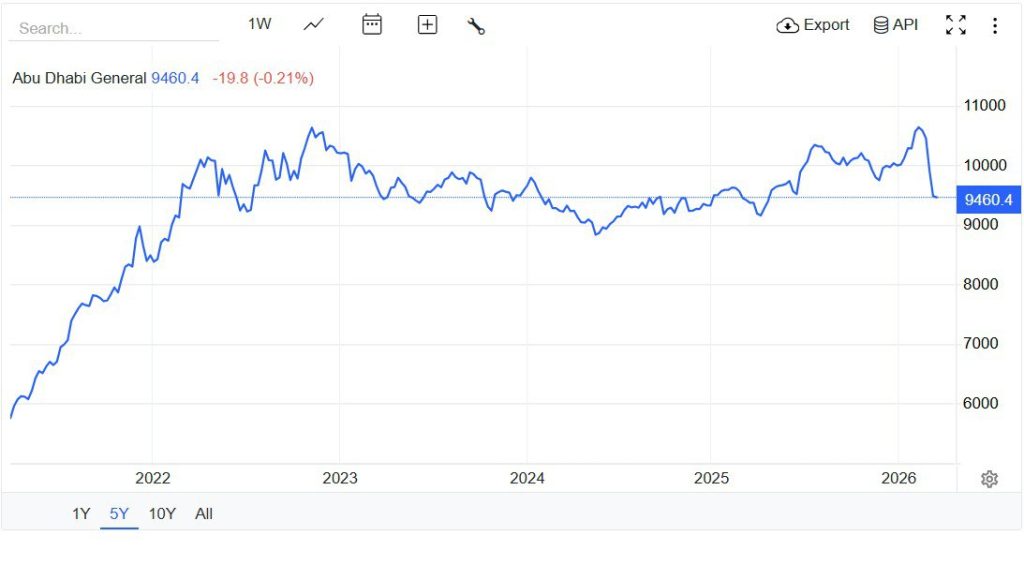
However, this recent drop is part of a broader trend. Looking at the dynamics of recent years, it becomes apparent that since 2022 the growth of Dubai’s stock market index has been very limited. This sharply contrasts with most emerging market indices, many of which have shown relatively strong growth over the same period.
This gap is prompting investors to take a closer look at the fundamentals of Dubai’s economy. Questions about its resilience have already been raised in previous years. Around four years ago, analysts were already discussing the possible slowdown of a growth model heavily dependent on real estate, tourism, and financial services.
A similar pattern can be observed in Qatar. The country’s stock market index has declined by nearly 9% over the past month. At the same time, the Qatari market also shows signs of prolonged stagnation. While stagnation in Dubai became noticeable around 2022, in Qatar it has been evident since 2023. Since then, the index has moved within a relatively narrow range without a clear upward trend.
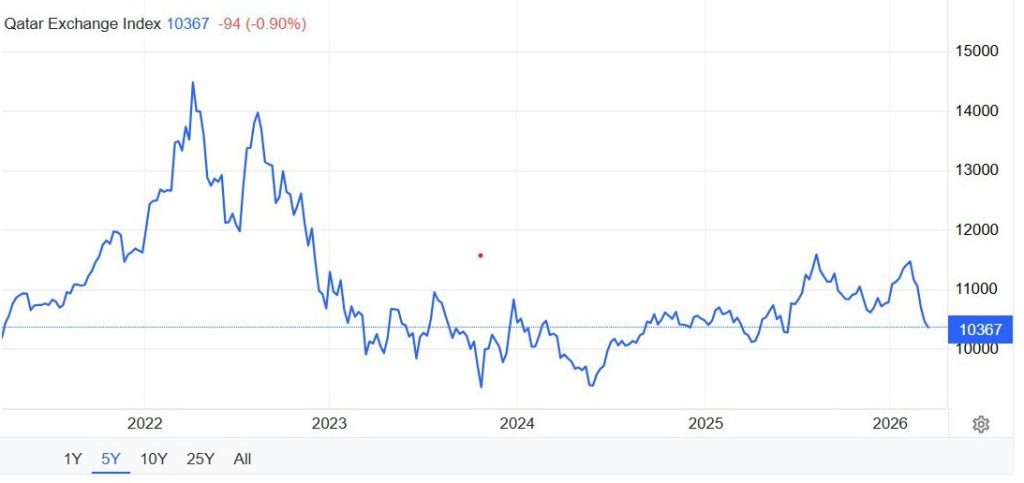
More broadly, the economies of Persian Gulf countries have been showing signs of cooling for several years. In Bahrain, for example, the stock market has been largely stagnant since the beginning of 2022.
The reasons behind this situation may be diverse: structural limitations of regional economic models, fluctuations in energy prices, and shifts in global capital flows. Geopolitical instability only amplifies these factors, reducing international investors’ appetite for regional assets.
