

The U.S. economy continues to expand. Analysts expect American GDP to grow by 2.7% in 2025. For a developed country, that is a solid and sustainable pace. Yet employment has barely increased. The gap between GDP growth and job creation has reached levels previously seen only in the aftermath of crises. The economy is formally in an expansion phase. Nevertheless, companies are increasing output, improving margins, and boosting productivity without creating new jobs.
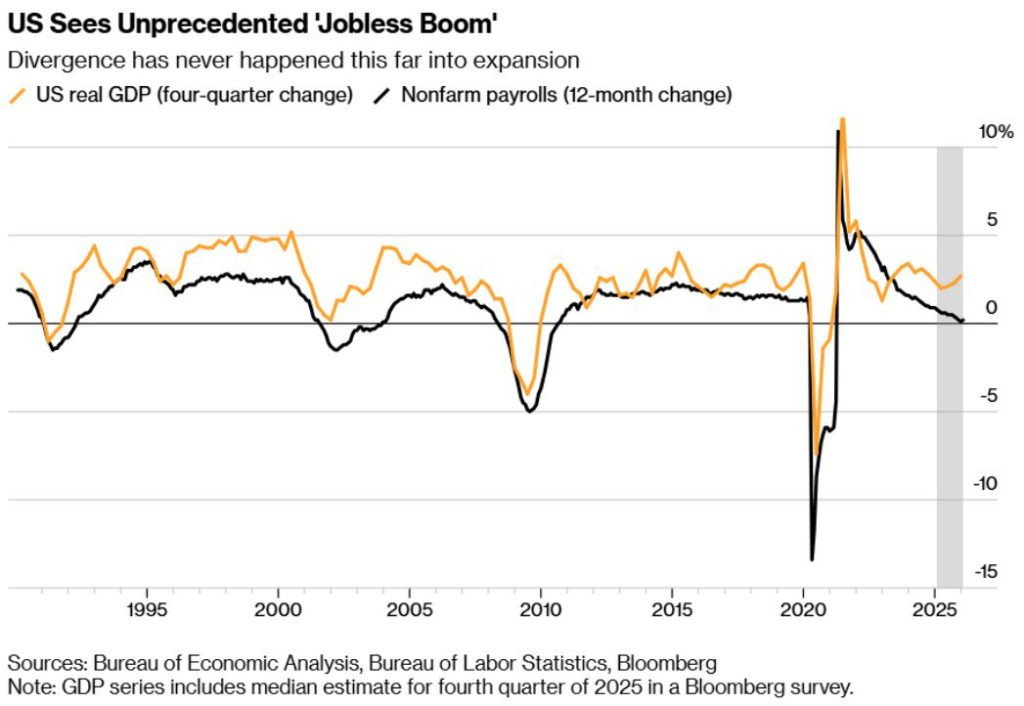
Economists compare the current situation to the early 2000s, when, after the collapse of the tech bubble, the United States experienced what was known as a “jobless recovery.” At that time, the economy had emerged from recession, but the labor market was slow to rebound. The key difference today, however, is fundamental. Twenty years ago, a recession had first destroyed jobs. This time, there has been no recession. Growth continues, but employment is not following. Such a phenomenon has never occurred before in postwar U.S. history.
If the link between economic growth and job creation once seemed almost axiomatic, it now appears more like a legacy of the industrial era. Productivity is rising thanks to technology faster than new jobs are being created. Artificial intelligence, automation, and digitalization allow companies to produce more with fewer employees. In logistics, algorithms manage flows; in offices, analytical systems replace part of routine work; in media and creative industries, generative models perform tasks once done by humans. Even where human workers remain essential, fewer of them are needed. This does not yet resemble mass unemployment. But growth is becoming less and less dependent on expanding employment. For the first time in decades, there is a sense that technological progress is no longer simply reallocating labor across sectors, but reducing overall demand for it.
For policymakers, this is troubling news. Economic growth remains a central measure of success, especially in a context of global competition and mounting geopolitical tensions. Yet if growth no longer creates jobs, it ceases to serve as a universal source of social stability. Income becomes concentrated in high-tech and capital-intensive sectors, while the middle class’s sense of economic security weakens.
In this context, two paths emerge. One is to prioritize technological efficiency while accepting a structural contraction of the labor market. The other is to offset this trend through an expansion of public-sector employment, creating administrative and social roles. However, such a model could lead to formal employment without real economic necessity, what anthropologist David Graeber famously described as “bullshit jobs.”
