



The growing unaffordability of housing for young people in developed countries has far more profound consequences than might appear at first glance. At the level of individual families, this manifests itself in postponed purchases, disrupted plans and slowly fading hopes of owning a home. But at the generational level, a completely new behavioural logic is emerging. Graphs show that every year, the proportion of young Americans who believe they will rent their entire lives is growing. Among those who formally intend to buy a home, millions do not have a penny in savings for a down payment. This is a consequence of a market structure that has finally spiralled out of the middle class’s control.
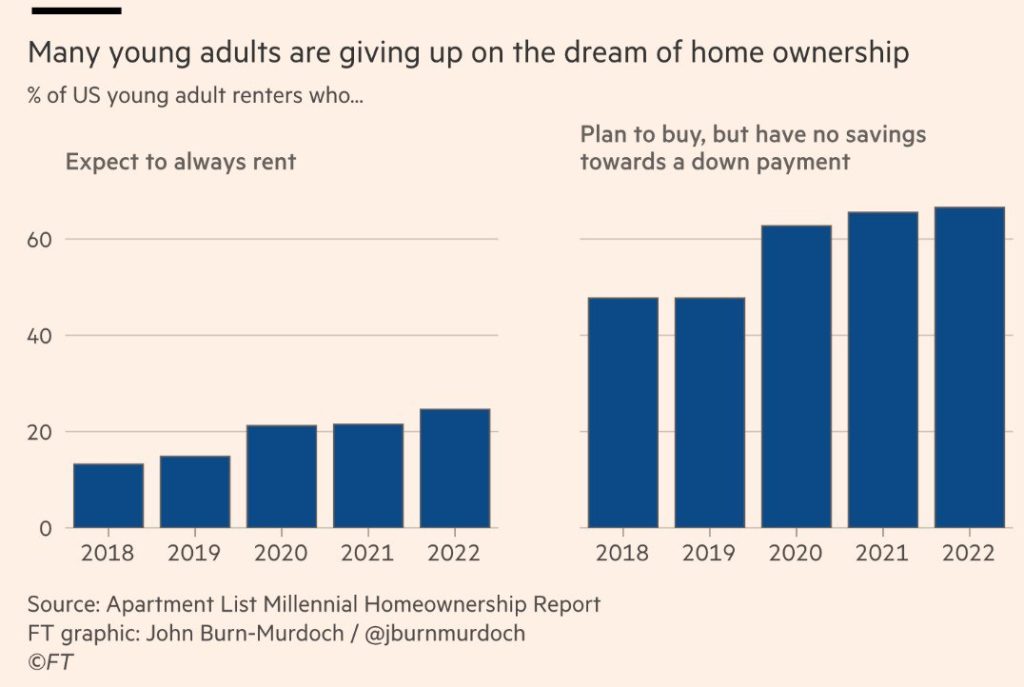
Researchers from the University of Chicago and Northwestern University, after analysing transaction data, behavioural panels and household surveys, have shown what this gap between expectations and reality leads to. Young people are increasingly cutting back on labour costs, switching to a more relaxed lifestyle, spending more on entertainment and becoming more daring in their use of risky financial instruments. If saving for a home is unattainable anyway, there is no point in saving, and even less point in overloading oneself with work in the hope of achieving a distant and increasingly mythical goal.
Seung Hyeong Lee and Younggeun Yoo come to similar conclusions. Their work clearly shows that affordable housing is the foundation of work motivation. Those who have a realistic prospect of buying a home in the foreseeable future work harder and take fewer risks. Those who consider themselves ‘out of the running’ in the housing market change their behaviour accordingly. They put less effort into their work, take more high-risk gambles, and place more faith in financial games that might once have seemed crazy.
This is also where we see the accelerating rise of cryptocurrencies. For young people deprived of the classic path to capital accumulation, the crypto market becomes the only channel for a possible upward leap. It is an attempt to take advantage of the only remaining window of opportunity. When you realise that within the traditional economy you will not be able to save up for a house in ten or twenty years, betting on volatile assets begins to seem rational.
American commentator Kyla Scanlon called this ‘financial nihilism.’ If the basic goal of home ownership and family becomes unattainable, the very morality of economic behaviour collapses. Respect for the norms of saving, work ethic, and long-term planning disappears, and a generation emerges that lives for today. As a result, if the housing market remains out of reach for young people, the nature of the economy, political processes, and the overall vector of social development will inevitably change.
