



Recently, the European Union has been periodically compared to the USSR. However, are there really any similarities between them? If we look at the raw statistics, the parallels with the late USSR are indeed much closer than is commonly thought. This is especially true when it comes to income redistribution.
The equality factor: what the data shows
The Gini coefficient is a key indicator of social stratification. The lower it is, the more evenly income is distributed in society. In the USSR, the idea of equality was at the very foundation of the social structure, and the figures confirm this. In 1980, the Soviet Gini coefficient was around 0.29. And now, forty years later, it is the European Union that shows a comparable level of inequality. And not just individual countries, but the entire bloc, with an average of about 0.31. Looking at specific countries, Iceland has a coefficient of 0.26, Finland 0.28, Denmark 0.29, Sweden 0.31, and Slovakia and Slovenia 0.24.
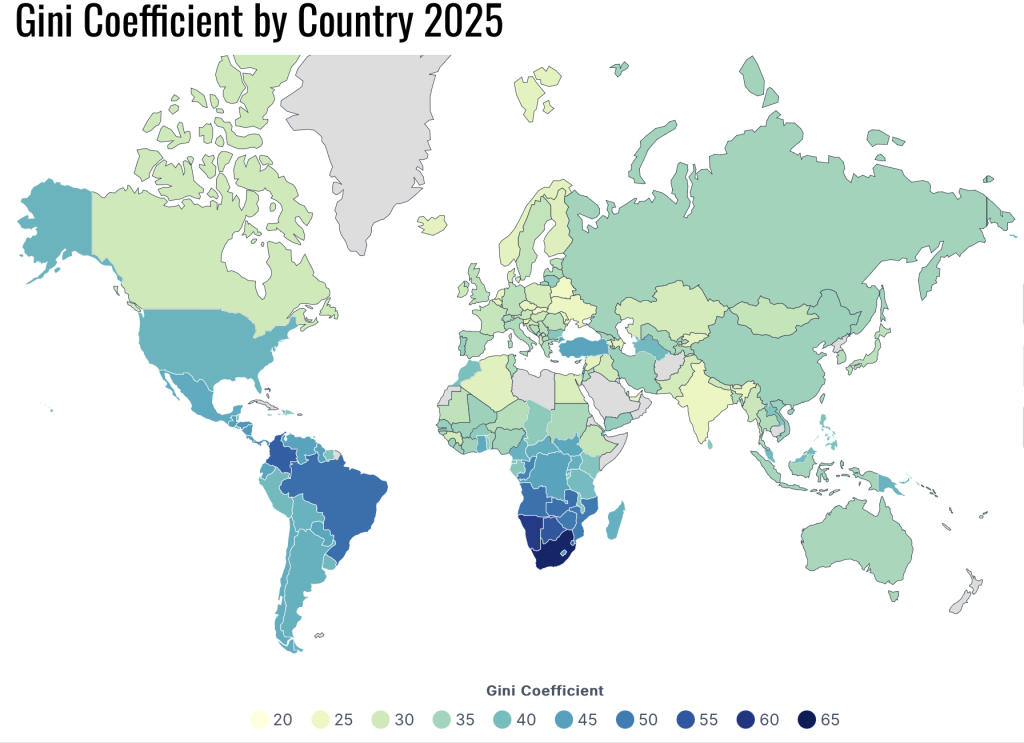
In other words, inequality in Scandinavia and Central Europe is actually lower than it was in the USSR at the height of its social justice. Today, the EU is one of the most redistributive regions in the world, with high taxes and high social spending.
It is interesting to note that in modern Russia, the Gini coefficient is 0.41. This is the same level as in the United States or China, countries where capitalism operates in its most rigorous and competitive form, and social redistribution is minimal compared to Europe. It turns out that modern Russia is closer to liberal economic models than to social democratic ones in terms of its structure of inequality. In other words, Russia and the EU are currently at opposite ends of the scale.
